




In today’s digital marketplace, many entrepreneurs wonder how small businesses can compete successfully with larger businesses when big brands seem to dominate search results, advertising platforms, and social media feeds.
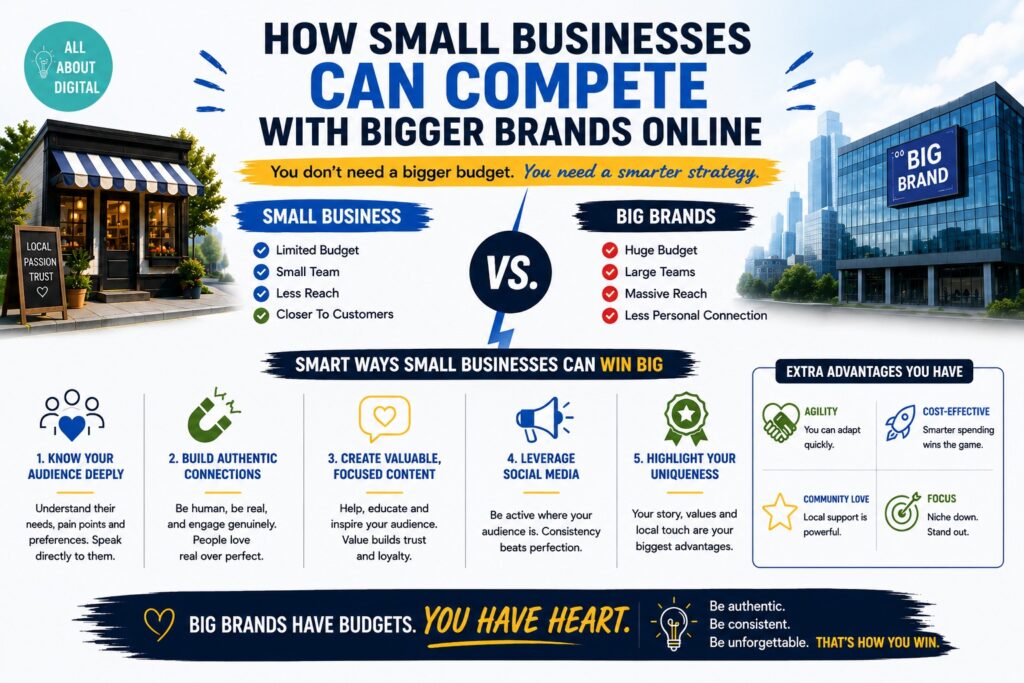
Large corporations often have bigger marketing budgets, larger teams, advanced technology, and strong brand recognition. However, online success is not determined by budget alone. In fact, many small businesses outperform larger competitors by being more focused, more responsive, and more connected to their customers.
The truth is that small businesses have unique advantages that big companies often struggle to replicate. By leveraging these strengths strategically, even a local business can build a strong online presence, attract loyal customers, and grow steadily.
In this guide, we’ll explore how small business can compete with large business organizations online and the practical strategies that help smaller companies succeed in competitive markets.
Why Small Businesses Have an Advantage
Many business owners assume that bigger automatically means better. While large companies have resources, they also face challenges such as slow decision-making, complex organizational structures, and less personalized customer interactions.
Small businesses can often:
- Adapt quickly to market changes
- Build stronger customer relationships
- Provide personalized service
- Create authentic content
- Target niche audiences more effectively
These advantages make it possible to compete successfully without matching the budget of a larger competitor.
Focus on a Specific Niche
One of the most effective answers to the question “how can small businesses compete successfully with larger businesses?” is by narrowing their focus.
Large brands often try to appeal to broad audiences. While this increases reach, it can also make their messaging generic.
Small businesses can stand out by serving a specific niche.
Examples:
Instead of targeting:
- “Digital Marketing Services”
Target:
- Digital Marketing for Restaurants
- SEO for Local Law Firms
- Social Media Marketing for Beauty Salons
Instead of:
- “Fitness Training”
Target:
- Weight Loss Coaching for Busy Professionals
- Strength Training for Women Over 40
Why Niche Marketing Works
When customers feel that your business understands their specific needs, they are more likely to:
- Trust your expertise
- Engage with your content
- Choose your services
- Refer others
Specialization often beats generalization.
Build Stronger Customer Relationships
One area where small businesses consistently outperform large corporations is relationship building.
Big brands often struggle to provide personalized interactions because they serve thousands or millions of customers.
Small businesses can:
- Respond personally to inquiries
- Remember customer preferences
- Provide customized recommendations
- Follow up after purchases
These actions create loyalty and trust.
Practical Ways to Build Relationships
- Reply quickly to messages
- Use customers’ names when communicating
- Thank customers publicly
- Ask for feedback
- Engage on social media
Customers often stay loyal because of relationships, not just products.
Use Local SEO to Gain Visibility
Many business owners searching for how to compete against big companies overlook one of the most powerful opportunities available: Local SEO.
Large corporations often dominate national search terms. However, local businesses can frequently outrank them for geographically targeted searches.
Optimize for Local Search
Focus on:
- City-specific keywords
- Neighborhood keywords
- Service-area keywords
- Google Business Profile optimization
Examples:
- Best Digital Marketing Agency in Kolkata
- Wedding Photographer in Salt Lake
- Interior Designer in South Kolkata
Build a Strong Local Presence
A strong local presence includes:
- Updated Google Business Profile
- Accurate business information
- Customer reviews
- Location-specific content
- Local citations
These factors help nearby customers find and trust your business.
Create Helpful Content Consistently
Content marketing allows small businesses to compete with larger companies without spending heavily on advertising.
Helpful content attracts visitors, builds authority, and generates leads over time.
Effective Content Types
- Blog posts
- FAQs
- Case studies
- How-to guides
- Videos
- Infographics
Why Content Marketing Works
Customers search for answers before making purchasing decisions.
When your content solves problems, your business becomes a trusted resource.
For example:
A local accounting firm can create content such as:
- Tax-saving tips for small businesses
- GST filing guides
- Financial planning advice
This builds credibility long before a customer needs accounting services.
Use Social Media Authentically
One of the biggest advantages small businesses have is authenticity.
Large brands often create highly polished content that can feel corporate or scripted.
Small businesses can connect with audiences by being more relatable.
Content Ideas
- Behind-the-scenes videos
- Employee spotlights
- Customer success stories
- Day-in-the-life content
- Business journey updates
Why Authenticity Wins
People trust people more than logos.
Authentic social media content creates stronger emotional connections and encourages engagement.
Many viral social media campaigns come from small businesses simply sharing real experiences and genuine stories.
Spend Advertising Budgets Strategically
You don’t need a massive advertising budget to compete online.
What matters is efficiency.
Small businesses should focus on reaching the right audience rather than the largest audience.
Smart Advertising Strategies
- Target specific locations
- Use audience segmentation
- Retarget website visitors
- Focus on high-intent keywords
- Test small campaigns first
Avoid Common Mistakes
Many businesses waste money by:
- Targeting broad audiences
- Using generic ad copy
- Sending traffic to homepages
- Ignoring conversion tracking
Precision often produces better results than scale.
Deliver a Better Customer Experience
Customer experience is one of the strongest competitive advantages for small businesses.
Many customers choose local companies because they appreciate:
- Faster responses
- Personalized service
- Easier communication
- Greater flexibility
Improve Your Online Experience
Make sure your business offers:
- Fast-loading websites
- Mobile-friendly design
- Simple navigation
- Easy checkout processes
- Transparent pricing
A smooth customer experience often influences buying decisions more than brand size.
Use Storytelling to Differentiate Your Brand
Large corporations often focus heavily on products and features.
Small businesses can stand out through storytelling.
Stories create emotional connections that advertising alone cannot achieve.
Stories You Can Share
- Why you started the business
- Challenges you’ve overcome
- Customer success stories
- Team experiences
- Community involvement
Benefits of Storytelling
Storytelling helps:
- Build trust
- Increase brand recall
- Create emotional engagement
- Differentiate your business
Customers remember stories long after they forget advertisements.
Attract and Retain Great Talent
Many entrepreneurs also ask how small companies can compete with big brands for talent.
Large organizations often offer higher salaries and extensive benefits, making recruitment challenging.
However, small businesses have unique advantages that attract professionals.
How Small Companies Can Compete With Big Brands for Talent
Offer:
- Flexible work environments
- Faster career growth
- Greater responsibility
- Direct access to leadership
- Strong workplace culture
Many talented professionals prefer meaningful work, flexibility, and growth opportunities over corporate structures.
Highlight Your Culture
Show potential employees:
- Team activities
- Learning opportunities
- Company values
- Career development pathways
This helps smaller companies attract motivated individuals despite larger competitors.
Learn From Competitive Markets
Business owners often wonder what strategies enabled big businesses to eliminate competition in certain industries.
Historically, successful companies have grown by:
- Improving customer experience
- Innovating consistently
- Creating strong brand recognition
- Building customer loyalty
- Leveraging technology
Instead of fearing competition, small businesses can study these strategies and adapt them on a smaller scale.
The goal isn’t to become a giant corporation overnight. The goal is to create sustainable competitive advantages within your market.
Avoid Losing Business to Your Competitors
One of the biggest challenges facing small businesses is learning how to avoid losing business to your competitors.
Customers often compare multiple providers before making decisions.
Common Reasons Customers Choose Competitors
- Slow response times
- Unclear pricing
- Poor reviews
- Weak online presence
- Lack of trust signals
How to Prevent Customer Loss
- Respond quickly
- Showcase customer reviews
- Provide clear information
- Offer valuable content
- Improve customer support
Small improvements in these areas can significantly increase customer retention and lead generation.
Learn From Successful Small Businesses
Businesses such as V S Enterprises and other growing local companies often demonstrate how smaller organizations can succeed against larger competitors.
Their success usually comes from:
- Strong local presence
- Customer-focused service
- Industry expertise
- Effective digital marketing
- Consistent relationship building
The lesson is clear: success isn’t determined solely by company size. Strategy matters far more than scale.
Track Performance and Improve Continuously
Data-driven decision-making is critical for growth.
Small businesses cannot afford to invest in tactics that don’t produce results.
Metrics to Monitor
- Website traffic
- Lead generation
- Conversion rates
- Search rankings
- Customer acquisition costs
- Social media engagement
Why Tracking Matters
Tracking helps identify:
- What’s working
- What’s wasting resources
- Which channels drive leads
- Which content performs best
Continuous improvement creates long-term growth.
Practical Action Plan for Small Businesses
If you’re looking for a straightforward roadmap on how small business can compete with large business, start with these steps:
Step 1
Choose a clear niche and audience.
Step 2
Optimize your website for conversions.
Step 3
Strengthen your local SEO presence.
Step 4
Create educational content consistently.
Step 5
Use social media authentically.
Step 6
Invest in targeted advertising.
Step 7
Improve customer experience.
Step 8
Track results and optimize regularly.
Following these steps consistently can help small businesses compete effectively, regardless of industry.
Conclusion
Competing online against larger companies may seem challenging, but it is entirely possible. Small businesses do not need to outspend big brands to succeed. They simply need to be more focused, more agile, and more customer-centric.
By understanding how can small businesses compete successfully with larger businesses, building meaningful customer relationships, leveraging local SEO, creating valuable content, and delivering exceptional experiences, smaller companies can establish a strong competitive position.
Whether you’re learning how to compete against big companies, exploring how small companies can compete with big brands for talent, or looking for ways to avoid losing business to your competitors, the key is consistency and strategic execution.
At All About Digital, we help small and growing businesses compete effectively in the digital space through SEO, local SEO, content marketing, social media management, website optimization, lead generation, and performance marketing strategies. Our goal is to help businesses build visibility, attract qualified customers, and create sustainable growth—even in highly competitive industries.
With the right digital strategy, small businesses can do more than compete with larger brands—they can outperform them in the areas that matter most: trust, customer relationships, and long-term loyalty.