




Digital marketing is evolving faster than ever. With AI-powered tools, privacy-first tracking, short-form video dominance, and changing search algorithms, businesses need to adapt quickly to stay ahead. Unfortunately, many brands continue to repeat the same digital marketing mistakes, leading to wasted budgets, poor ROI, and lost opportunities.
If you want to grow your business in 2026, avoiding these mistakes is just as important as implementing the right strategies. In this guide, we’ll cover the biggest digital marketing mistakes, including common SEO mistakes to avoid in 2026, common mistakes to avoid in Google Ads, and common marketing automation mistakes in 2026, along with practical solutions to help your business succeed.
1. Treating AI as a Complete Replacement for Human Creativity
The Mistake
Many businesses rely entirely on AI tools to create blogs, social media posts, ad copy, and even marketing strategies without human review.
Why It Hurts
AI can generate content quickly, but it may include inaccurate information, repetitive messaging, or content that doesn’t reflect your brand’s personality. This has become one of the biggest digital marketing mistakes businesses make in 2026.
The Solution
Use AI for brainstorming and first drafts.
Review every piece of content for accuracy and brand voice.
Add human creativity, storytelling, and industry expertise.
Maintain an AI quality checklist before publishing.
2. Ignoring First-Party Data and Privacy Changes
The Mistake
Many marketers still depend heavily on third-party cookies and platform-generated audience data.
Why It Hurts
Privacy regulations continue to reshape digital advertising. Businesses without first-party data lose valuable customer insights and targeting accuracy.
The Solution
Build email subscriber lists.
Collect customer preferences through forms and surveys.
Implement server-side tracking.
Focus on contextual advertising and customer-owned data.
3. Focusing Only on Last-Click Attribution
The Mistake
Giving all credit to the final conversion source.
Why It Hurts
Customers interact with multiple touchpoints before making a purchase. Ignoring earlier interactions creates poor marketing decisions.
The Solution
Use multi-touch attribution.
Measure assisted conversions.
Perform incrementality testing.
Analyze the entire customer journey.
4. Ignoring Short-Form Video Marketing
The Mistake
Posting occasional videos or simply cutting long videos into short clips without optimization.
Why It Hurts
Platforms like Instagram Reels, YouTube Shorts, and TikTok prioritize engaging native content. Businesses that ignore video often lose organic reach.
The Solution
Hook viewers within the first three seconds.
Create platform-specific vertical videos.
Add captions.
Include one clear CTA in every video.
5. Making Common SEO Mistakes to Avoid in 2026
The Mistake
Many businesses still target outdated keywords, ignore search intent, publish thin content, and neglect technical SEO.
These remain some of the common SEO mistakes to avoid in 2026.
Why It Hurts
Google increasingly rewards helpful, experience-driven, and user-focused content. Poor SEO practices result in lower rankings and declining organic traffic.
The Solution
Research search intent before creating content.
Optimize Core Web Vitals and page speed.
Build topical authority with comprehensive content.
Update existing blogs regularly.
Focus on E-E-A-T (Experience, Expertise, Authoritativeness, Trustworthiness).
6. Making Common Mistakes to Avoid in Google Ads
The Mistake
Running campaigns without conversion tracking, poor audience targeting, irrelevant keywords, or low-quality landing pages.
These are among the common mistakes to avoid in Google Ads that waste advertising budgets.
Why It Hurts
Poor campaign optimization leads to higher CPC, lower Quality Scores, and fewer qualified leads.
The Solution
Set up accurate conversion tracking.
Regularly optimize negative keywords.
Improve landing page experience.
Test multiple ad variations.
Review campaign performance weekly.
7. Making Common Marketing Automation Mistakes in 2026
The Mistake
Businesses automate everything—from email sequences to customer follow-ups—without personalization or monitoring.
These common marketing automation mistakes in 2026 often damage customer relationships instead of improving them.
Why It Hurts
Generic automation feels robotic, increases unsubscribe rates, and reduces engagement.
The Solution
Segment audiences properly.
Personalize workflows using behavior and interests.
Regularly review automation performance.
Keep human intervention where necessary.
Continuously optimize email journeys.
8. Not Testing Creative Assets Regularly
The Mistake
Using the same advertisements and creatives for several months.
Why It Hurts
Creative fatigue lowers CTR, engagement, and conversion rates.
The Solution
Perform continuous A/B testing.
Test different headlines, images, videos, and CTAs.
Refresh creatives every few weeks.
Monitor engagement metrics closely.
9. Poor Cross-Channel Marketing Coordination
The Mistake
SEO, Google Ads, email marketing, and social media teams operate independently.
Why It Hurts
Customers receive inconsistent messaging, reducing trust and conversion rates.
The Solution
Maintain a unified content calendar.
Align messaging across every marketing channel.
Share campaign insights across teams.
Create consistent offers and branding.
Conclusion
The digital marketing mistakes that hurt businesses in 2026 are no longer just technical—they’re strategic. Whether it’s relying too heavily on AI, making common SEO mistakes to avoid in 2026, committing common mistakes to avoid in Google Ads, or falling into common marketing automation mistakes in 2026, every mistake impacts your visibility, conversions, and long-term growth.
The good news is that each of these challenges has a proven solution. Businesses that continuously optimize, test, personalize, and adapt their marketing strategies will outperform competitors in today’s rapidly evolving digital landscape.
At All About Digital, we help businesses avoid these costly mistakes with data-driven SEO, Google Ads management, AI-powered marketing automation, performance marketing, social media strategy, and conversion-focused web solutions. Our team stays ahead of the latest digital marketing trends to ensure your business achieves sustainable growth, better ROI, and long-term online success.
If you’re ready to eliminate costly marketing mistakes and accelerate your digital growth in 2026, All About Digital is here to help.
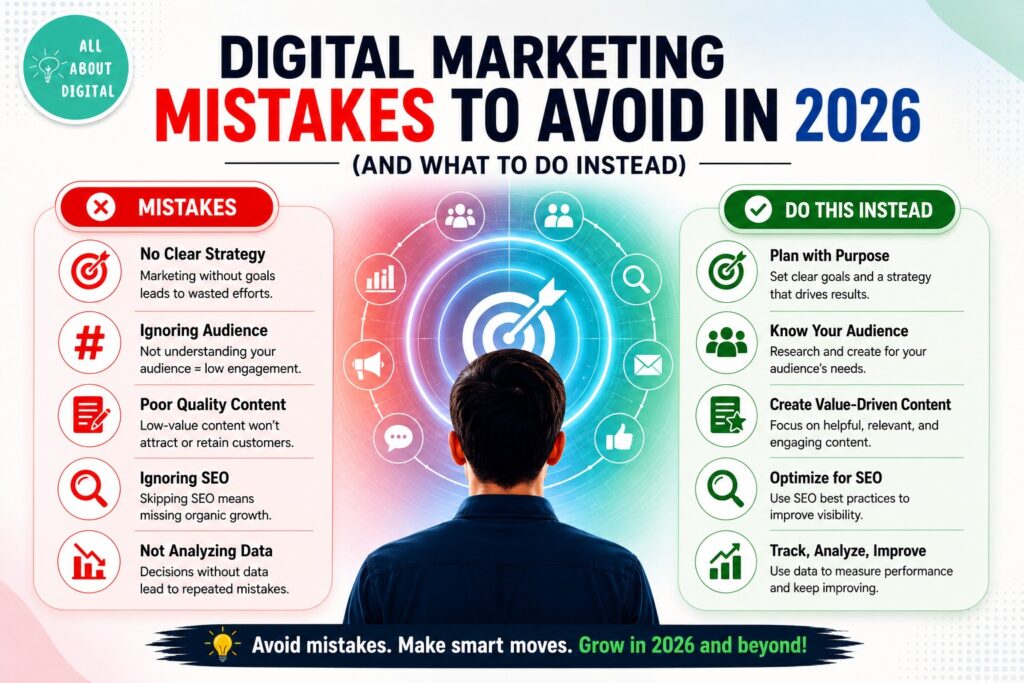
9. Underinvesting in creative production systems
Mistake: Treating creative as an occasional task rather than a production discipline.
Why it fails: Slow, expensive creative bottlenecks limit campaign velocity.
Do instead: Set up a creative ops process with templates, asset libraries, a rapid-iteration workflow, and AI-assisted drafting plus human polish. Outsource bursts to vetted studios for scale.
10. Failing to prioritize customer retention
Mistake: Chasing new customers while ignoring retention and lifecycle value.
Why it fails: Acquisition costs rise; retention drives profitability and advocacy.
Do instead: Invest in post-purchase journeys, loyalty features, subscription options, and reactivation flows. Measure and optimize for customer lifetime value (LTV) and churn.
11. Not protecting brand safety and trust
Mistake: Running ads in low-quality or risky environments to chase cheap impressions.
Why it fails: Brand reputation and customer trust can suffer quickly.
Do instead: Use whitelists and contextual verification, monitor placements continuously, and set strict media quality signals. Bake in human review for high-sensitivity campaigns.
12. Relying only on vanity metrics
Mistake: Celebrating impressions, followers, or clicks without linking to business outcomes.
Why it fails: Vanity metrics don’t prove ROI and can hide underperforming tactics.
Do instead: Define KPIs tied to business outcomes (revenue per visitor, CAC, LTV, conversion rate). Use dashboards that tie marketing activity to sales or revenue metrics.
13. Ignoring emerging commerce touchpoints
Mistake: Treating commerce as only an e‑commerce site problem.
Why it fails: Social commerce, in-app checkout, and conversational commerce convert differently and are growing.
Do instead: Optimize product discovery and checkout experiences on social platforms, marketplaces, and chat channels. Test friction-minimizing payment and fulfillment flows.
14. Not preparing for regulatory changes
Mistake: Treating privacy and ad regulation as a last-minute compliance task.
Why it fails: Sudden policy changes can halt campaigns or lead to fines.
Do instead: Embed privacy-by-design: consent management, data minimization, and clear data-use communication. Keep legal and product teams in campaign planning.
15. Missing local and cultural nuance
Mistake: Deploying global creatives without adapting for local context or language.
Why it fails: Messaging can be tone-deaf or irrelevant across regions.
Do instead: Localize beyond translation — adapt imagery, references, pricing, and payment options to local preferences. Use local creators where possible.
Conclusion
2026 rewards marketers who combine human judgment with smart automation, prioritize privacy and first-party data, and treat creative as an ongoing production discipline. Avoid these mistakes by building flexible systems, measuring the right outcomes, and keeping the customer journey central.